
If you’re shopping for a home in Orange County right now, you’ve probably heard some version of this advice: “Just wait until rates come down.” It sounds reasonable. But after 15 years of helping buyers here, I can tell you that waiting has its own price tag. In many cases, using a seller concession to buy down your rate today can do more for your monthly budget than sitting on the sidelines.
Here’s how it works, with an illustrative example so you can see the math.
Where rates are right now
According to Freddie Mac’s Primary Mortgage Market Survey, the average 30-year fixed rate was 7.32% for the week of October 22, 2026, down slightly from 7.40% the week before. A year ago, for the week of October 23, 2025, the average was 6.19% (Freddie Mac PMMS), so rates have moved up over the past year, which is one more reason not to count on waiting. That survey reflects conventional, conforming loans for borrowers with strong credit and 20% down, so your own quote may be higher or lower.
Why “wait for lower rates” can backfire
Rates and home prices don’t move in a vacuum. When rates drop, more buyers can suddenly afford to shop, and they tend to jump back in at the same time. More buyers competing for the same homes usually means more multiple-offer situations, fewer price reductions, and less room to ask a seller for help.
Right now, many sellers are willing to help. Redfin reported that sellers gave concessions in 44.7% of U.S. home sales in the three months ending August 31, 2026, and the share was even higher in nearby Southern California metros: 56.2% in Los Angeles, 57.1% in San Diego, and 58.0% in Riverside (Redfin, September 18, 2026). Redfin’s report doesn’t list Orange County on its own, and every neighborhood is different, but the takeaway is simple: today, asking for seller help is a normal part of the conversation.
What a seller-paid rate buydown is
A seller concession is money the seller agrees to put toward your costs at closing. One smart way to use it is to “buy down” your interest rate. There are two common types:
- Temporary buydown (like a 2-1). The seller’s money goes into an account that lowers your payment for the first couple of years. In a 2-1 buydown, your rate is 2 percentage points lower in year one, 1 percentage point lower in year two, and then it goes to the full note rate for the rest of the loan.
- Permanent buydown. The seller pays points to the lender upfront, and you get a lower rate for the life of the loan. How much each point lowers your rate varies by lender and by day.
Keep in mind that lenders generally qualify you based on the full note-rate payment, not the reduced first-year payment.
Illustrative example: buy now with a buydown vs. wait a year
Here’s a side-by-side using round numbers. This is an illustrative example, not a quote, a forecast, or financial advice.
Assumptions:
- Home price: $900,000 today
- Loan: 30-year fixed conventional, 20% down ($180,000), loan amount $720,000
- Today’s rate: 7.32% (Freddie Mac PMMS, week of 10/22/2026)
- 2-1 buydown: 5.32% in year 1, 6.32% in year 2, 7.32% after that
- Permanent buydown: 2 points (2% of the loan, $14,400), assumed to lower the rate by 0.50% to 6.82%
- Wait scenario: you buy one year from now, the rate has dropped to 6.50%, and the same home costs 5% more ($945,000), still with 20% down and no seller help
- Payments shown are principal and interest only (no taxes, insurance, HOA, or mortgage insurance)
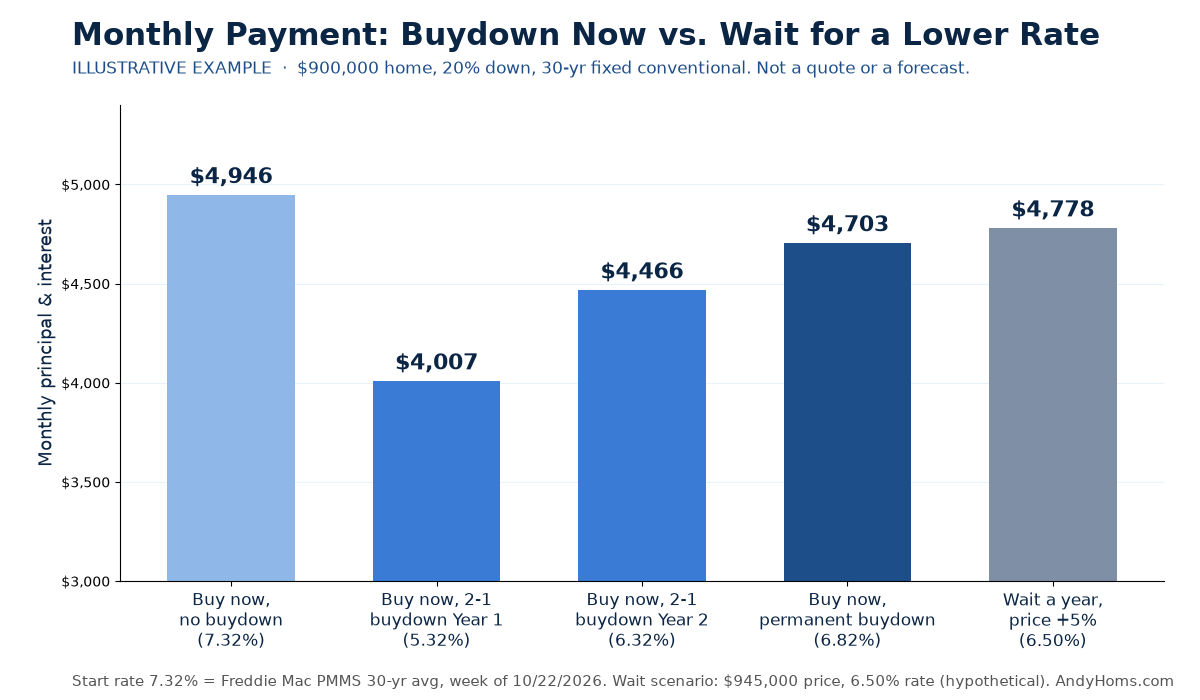
What the numbers show (illustrative example):
- 2-1 buydown now: About $4,007 a month in year one and $4,466 in year two, then $4,946. The seller concession needed is about $17,024. That’s the difference between the full payment and the reduced payments over 24 months.
- Permanent buydown now: About $4,703 a month for the life of the loan, with a $14,400 seller concession.
- Wait a year: About $4,778 a month at 6.50%, but on a bigger $756,000 loan. You’d also need about $9,000 more for the down payment, and you’d likely have less room to negotiate seller help.
Both seller concessions in this example are well under the 6% limit ($54,000) that applies to a conventional loan with 20% down.
Over the first two years of ownership, total principal and interest is about $101,678 with the 2-1 buydown, $112,883 with the permanent buydown, and $114,682 if you wait. Over the first five years, it’s about $279,730, $282,207, and $286,706. After five years, the buy-now loan balances are about $680,014 (2-1) and $676,427 (permanent), compared with about $707,699 for the wait-a-year buyer.
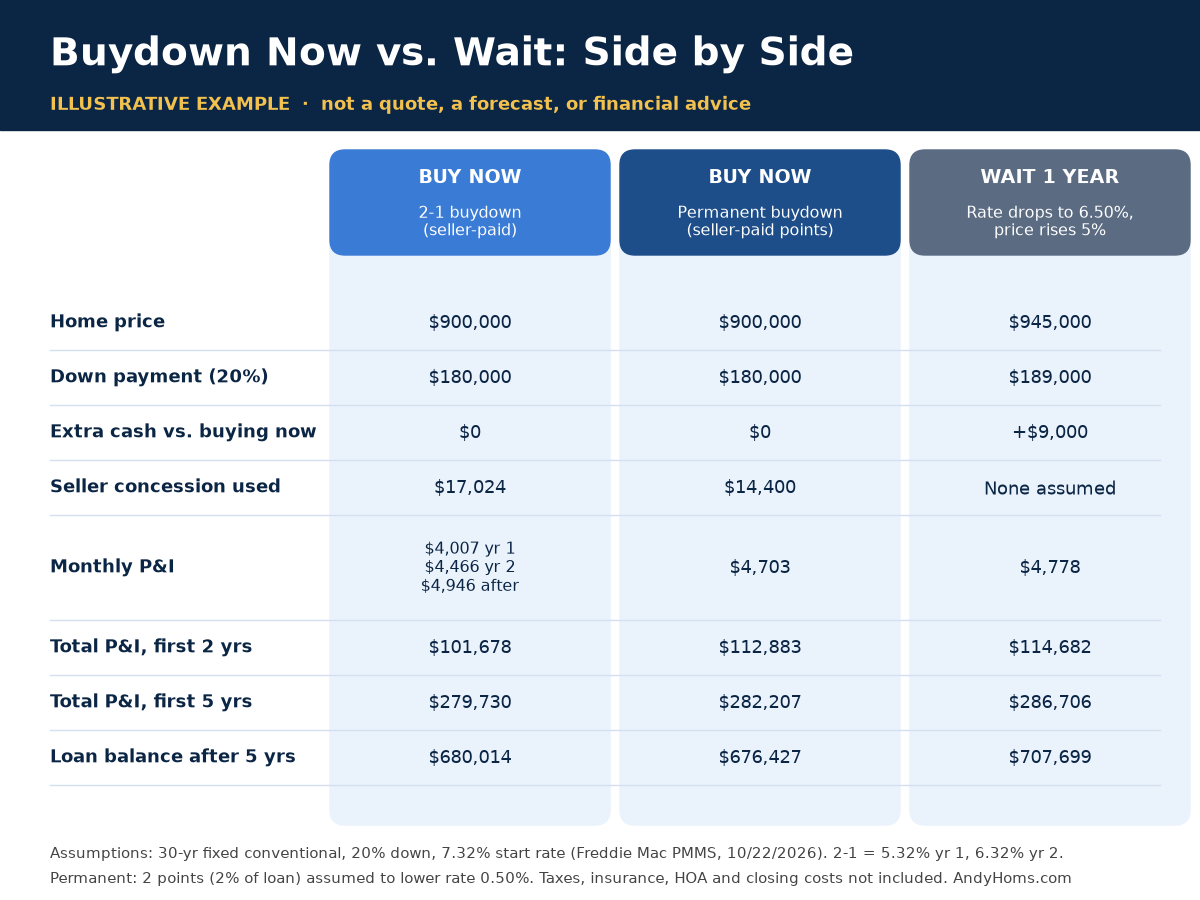
In this example, the permanent buydown gives you a lower payment today than waiting for a lower rate would, and the 2-1 buydown gives you the most breathing room in your first two years. And if rates do fall later, you may be able to refinance. That isn’t guaranteed, and refinancing has its own costs, so talk it through with your lender.
How much can a seller contribute?
Limits depend on your loan type, and buydowns count toward them:
- Conventional (Fannie Mae): For a primary home or second home, up to 3% of the price or appraised value (whichever is lower) with less than 10% down, 6% with 10% to just under 25% down, and 9% with 25% or more down (Fannie Mae Selling Guide B3-4.1-02).
- FHA: Up to 6% of the sales price (HUD Handbook 4000.1).
- VA: Seller concessions, including temporary buydowns, are capped at 4% of the reasonable value (VA Home Loans).
Concessions generally can’t go toward your down payment or exceed your actual closing costs. Your lender will confirm what applies to your loan, so talk with a lender before you write an offer.
The bottom line
Nobody can promise where rates or prices will go. But you can control the deal in front of you. When sellers are open to helping, a buydown can lower your payment now, without waiting and hoping the market cooperates. If you’d like to see what this could look like for your budget, check out my buyer resources or send me a message.
Let’s run your numbers
Call or text me at (949) 229-2704 or email Andy@AndyHoms.com. I’m happy to walk through your options and connect you with a trusted lender. No pressure, just straight answers.
This article is general information, not financial, tax, or legal advice. The illustrative example uses hypothetical numbers. Rates, programs, and seller concessions vary, so please talk with a licensed lender about your situation.
Andy Homs, Broker-Associate | H&M Realty Group | DRE #01893992 | Equal Housing Opportunity
Let’s talk
Thinking about a move? Let’s make it a smart one.
Whether you’re buying, selling, or investing in South Orange County, I’m happy to talk through your options. No pressure, just straight answers.
Andy Homs, Broker-Associate | H&M Realty Group | DRE #01893992 · Equal Housing Opportunity