
Losing a loved one is hard enough. Then come the questions about the house: Does it have to go through probate? Can it be sold? How long will it take? After 15 years of helping Orange County families, I’ve walked alongside many executors, administrators, and trustees through this. I’m not an attorney, and this post isn’t legal advice. But I can share how the process generally works in California, so you know what questions to bring to your attorney.
This is general information, not legal or tax advice. Talk with a California estate planning or probate attorney about your situation.
What is probate?
The California Courts describe probate as the legal process to transfer a person’s property after they die. The court appoints a personal representative, who collects the property, pays debts, and distributes what’s left. An estate may need probate even when there’s a will.
The court’s self-help glossary explains the two main titles (CA Courts):
- Executor: named in the will and appointed by the court.
- Administrator: appointed by the court when there’s no will, or no executor who can serve.
Signs a home may need to go through probate
According to the California Courts, property held in a living trust, in joint tenancy, with a transfer-on-death deed, or with named beneficiaries can often pass without probate (CA Courts). A home is more likely to involve probate when it was titled in the decedent’s name alone and not in a trust.
California also has simpler procedures for smaller estates. For deaths on or after April 1, 2025, the Judicial Council’s adjusted amounts include $208,850 for the small estate affidavit process and $750,000 for a petition involving the decedent’s primary residence (Judicial Council, Probate Code §890 adjusted amounts). Whether any of these apply depends on the details, which is exactly what an attorney can sort out.
How long does probate take?
The California Courts say a formal probate typically takes 9 to 18 months and can sometimes take longer. It generally moves through three stages: opening the case, administering the estate, and closing it. Along the way, assets are inventoried and appraised, and a probate referee values certain property.
How a probate home sale works
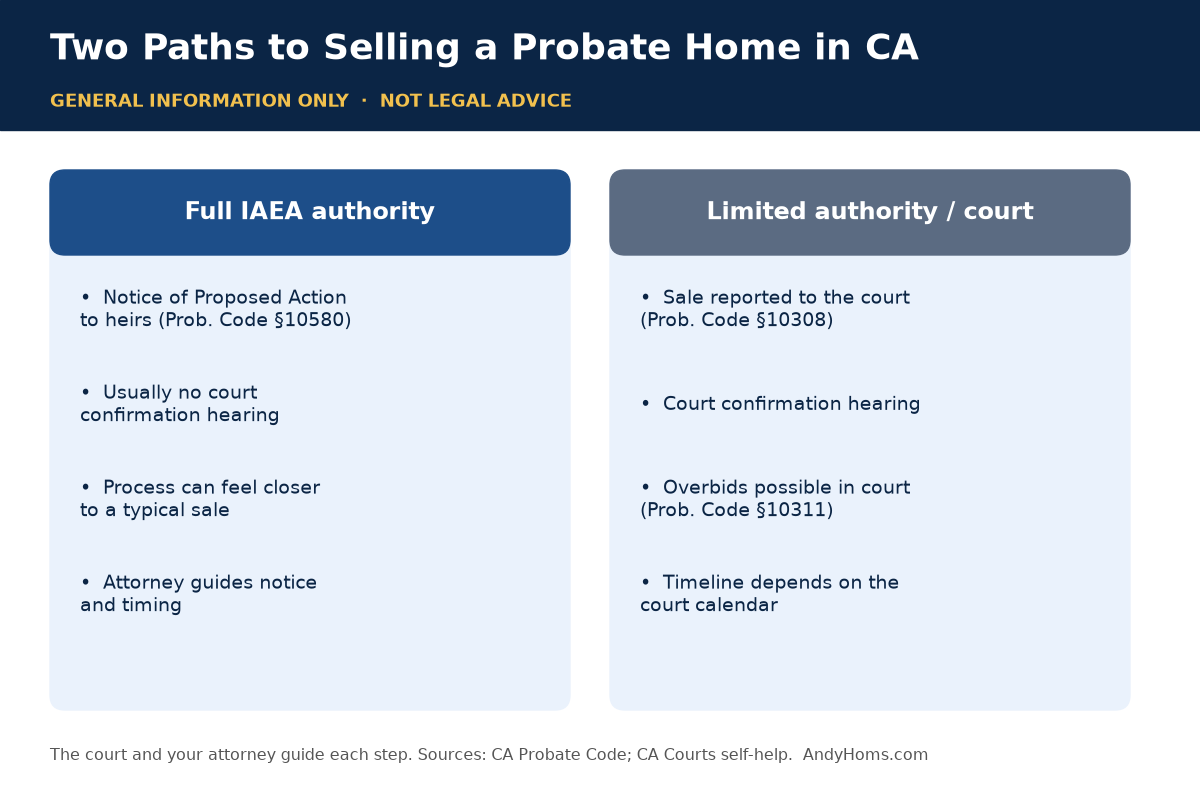
Once the court appoints the personal representative and issues letters, the home can be sold. How it’s sold depends on the authority the court grants under the Independent Administration of Estates Act (IAEA):
- Full authority: The representative may sell real property without a court confirmation hearing, after giving heirs a Notice of Proposed Action (Probate Code §10511, §10580). The court confirmation requirements generally don’t apply (§10503).
- Limited authority: The sale goes through court supervision (§10501). The accepted offer is reported to the court and must be confirmed (§10308).
Court confirmation and overbids. At a confirmation hearing, other buyers can bid in court. Under §10311, the first overbid must be at least 10% more on the first $10,000 of the original bid plus 5% more on the rest. On a hypothetical $800,000 accepted offer, that works out to $1,000 plus $39,500, so the minimum opening overbid would be $840,500. Buyers need to know this going in.
Timing. The court generally expects a petition for final distribution or a status report within one year after letters are issued, or 18 months if a federal estate tax return is required (§12200).
How living trusts can help avoid probate
The Orange County Superior Court’s self-help page on living trusts explains that when all of a person’s property is in a living trust, probate generally isn’t needed. The successor trustee can manage and distribute the property without court involvement. The court also notes that a trust only works for property that’s actually been transferred into it, and that many people use a “pour-over” will as a backup. The court recommends meeting with an estate planning lawyer, and so do I.
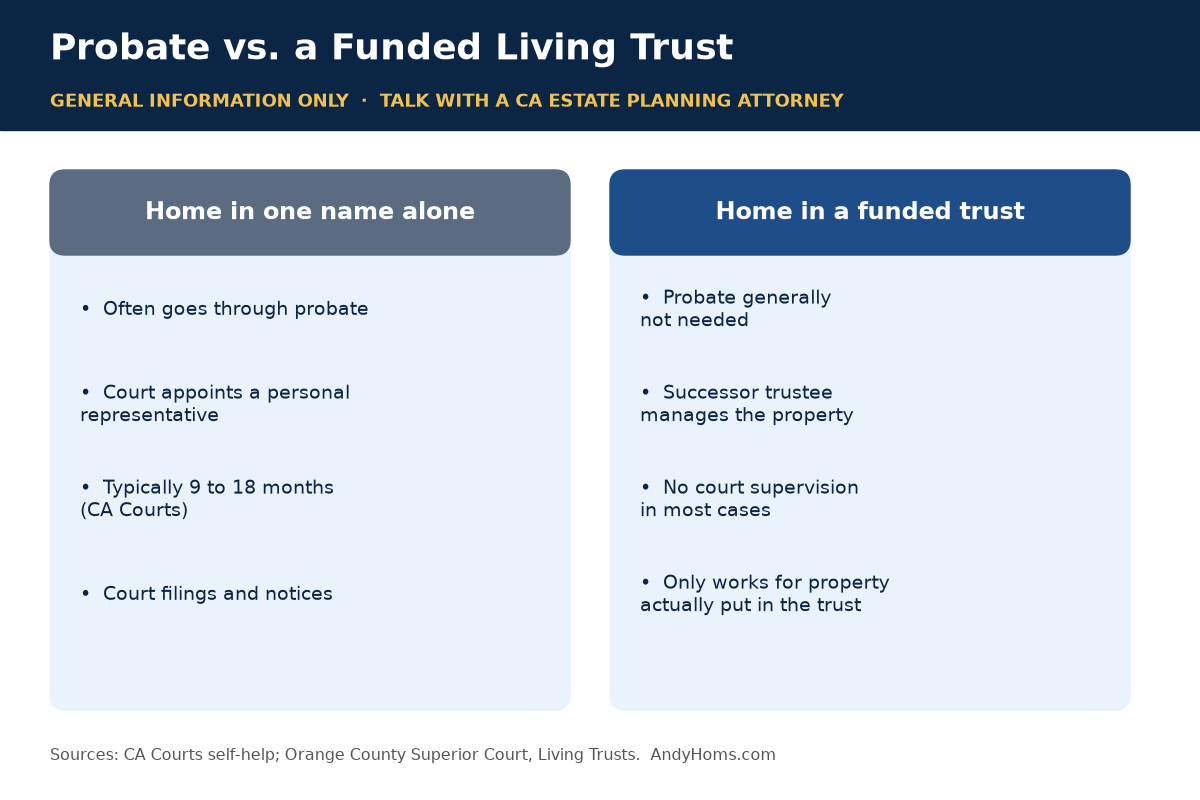
For trustees, selling a trust-owned home usually looks a lot like a regular sale, without court confirmation. Your attorney will confirm what applies.
Where I fit in
I’m your real estate resource, working alongside your attorney. For executors, administrators, and trustees, I help:
- Prepare the home, from cleanout to light repairs, when it makes sense.
- Price it using local market data, and explain how that compares to the probate appraisal.
- Market it to reach qualified buyers, and explain probate terms to buyers and their agents.
- Coordinate timelines and paperwork with your attorney, escrow, and the court process.
Need a referral? Just ask
Settling an estate can mean juggling a lot of moving parts. If it helps, I’m happy to share referrals to resources I know, including:
- Probate and estate planning attorneys
- Estate sale companies
- Cleanout and hauling services
- Contractors and repair professionals
- Appraisers
- Movers
These are simply referrals, and I can’t guarantee any provider’s work or results. You’re always free to choose your own providers.
Let’s talk
Whether you’re settling an estate or just planning ahead, I’m here to answer real estate questions. Visit my seller resources or send me a message. Call or text me at (949) 229-2704 or email Andy@AndyHoms.com.
This is general information, not legal or tax advice. Talk with a California estate planning or probate attorney about your situation.
Andy Homs, Broker-Associate | H&M Realty Group | DRE #01893992 | Equal Housing Opportunity
Let’s talk
Thinking about a move? Let’s make it a smart one.
Whether you’re buying, selling, or investing in South Orange County, I’m happy to talk through your options. No pressure, just straight answers.
Andy Homs, Broker-Associate | H&M Realty Group | DRE #01893992 · Equal Housing Opportunity