
If you own a home in Orange County, you’ve probably typed “what’s my home worth” into a search bar and gotten three different numbers from three different websites. That’s normal. Online estimates are a useful starting point, but they can’t walk through your front door. After 15 years in Southern California real estate, here’s how I think about home value in today’s market, why the online numbers can miss, and how a real home valuation works.
Today’s Orange County market at a glance
Here’s what the most recent published data shows (as of late October 2026):
- Single-family median price: $1,480,000 in September 2026, up 5.6% from $1,401,250 a year earlier, per the California Association of REALTORS® (C.A.R.). Orange County single-family sales were down 2.0% from a year ago.
- All home types: Redfin reports a median sale price of $1,207,298 for the three months ending September 2026, up 0.6% year over year, with a median of 47 days on market (down from 50).
- Pricing power: Per the same Redfin data, homes sold for 98.8% of list price on average in September. 28.1% sold above list, while 21.6% of listings had a price drop, up 3.6 points from a year ago.
- Mortgage rates: The 30-year fixed rate averaged 7.24% as of October 29, 2026, down from 7.32% the week before but up from 6.17% a year ago, according to Freddie Mac’s Primary Mortgage Market Survey.
Notice that the two “median price” numbers are very different. C.A.R. counts existing single-family detached homes only. Redfin includes condos and townhomes. Neither one is the value of your home. A county median describes the mix of homes that sold, not what any one house is worth. C.A.R. itself cautions that changes in median prices “should not be construed as actual price changes in specific homes.”
What I take from the numbers: well-priced homes are still selling close to asking, but more sellers are cutting prices than a year ago. In a market like this, getting the price right from day one matters.
Why online estimates can be off
Automated valuation models like Zillow’s Zestimate and the Redfin Estimate use public records, MLS data, and recent sales. They’re quick and free. But here’s what the companies themselves say about accuracy:
- Zillow reports a nationwide median error of 1.77% for homes on the market and 7.20% for off-market homes (Zillow). Median error means half of estimates are closer than that, and half are further off.
- Redfin reports a median error of 1.91% for on-market homes and 7.55% for off-market homes nationwide, and 6.68% for off-market homes in California (Redfin).
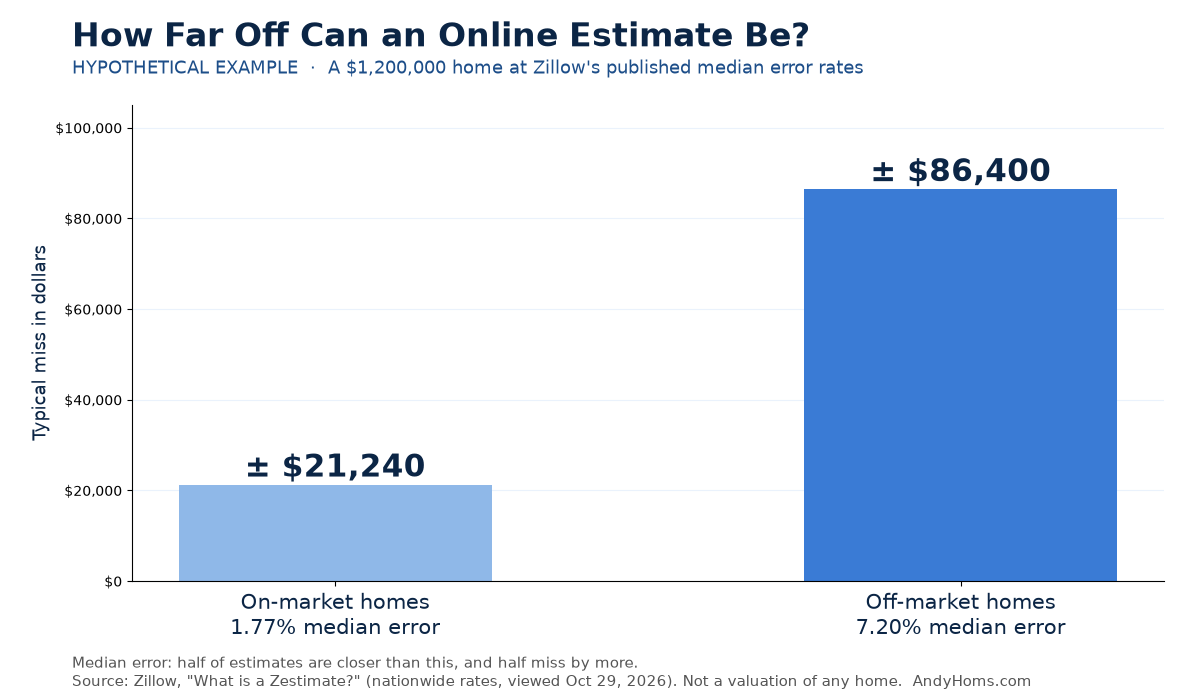
Why the bigger miss on off-market homes? If you’re not selling, the model doesn’t have your listing photos, description, or price to learn from. Zillow notes that unreported additions and remodels aren’t reflected in the Zestimate, and that it uses data from an area “up to the size of a county” when nearby sales are thin. Both companies say their estimates are not appraisals. Zillow even suggests requesting a comparative market analysis (CMA) from a real estate agent.
One more number that confuses people: your property tax assessed value. Under Proposition 13, your assessed value is generally set at purchase and can rise no more than 2% a year, so it often has little to do with today’s market value (California State Board of Equalization).
What actually drives your home’s value
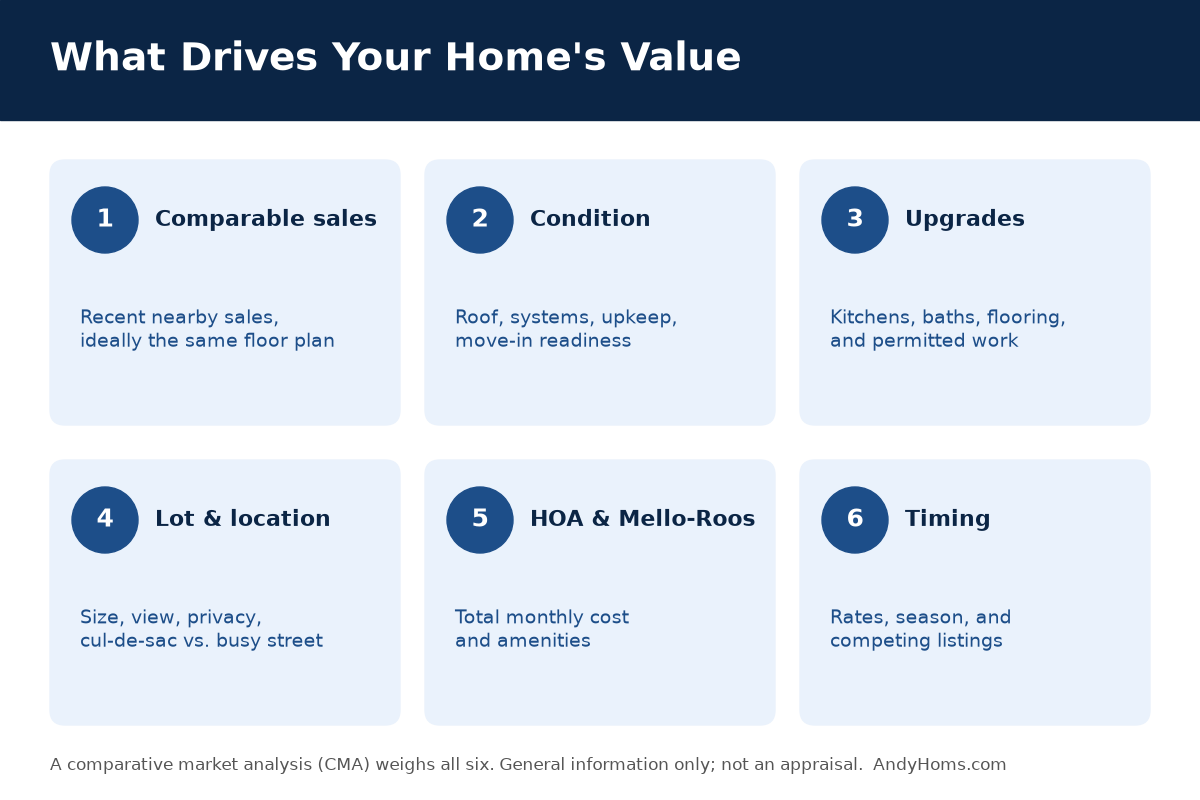
When I prepare a home valuation, these are the factors I weigh:
- Comparable sales (comps): Recent sales of similar homes in the same neighborhood, ideally the same floor plan. In master-planned communities across South Orange County, a sale in your tract usually tells me more than a sale a mile away with similar square footage.
- Condition: A well-kept home and one with deferred maintenance can sell for very different prices, even with the same floor plan. Buyers notice roofs, windows, HVAC, and plumbing.
- Upgrades: Remodeled kitchens and baths, flooring, and energy improvements can add value, but not dollar for dollar. Whether the work was permitted matters too.
- Lot and location: Lot size, usable yard, views, privacy, a quiet cul-de-sac versus backing a busy street, and proximity to parks, trails, and schools.
- HOA dues and Mello-Roos: Buyers look at total monthly cost, not just price. Higher dues or special taxes can affect what a buyer can afford, while strong amenities can add appeal.
- Timing and competition: Mortgage rates, the season, and how many similar homes are listed at the same time all shape what buyers will pay right now.
Online estimate vs. CMA vs. appraisal
- Online estimate: A computer-generated number based on the data available to the model. Useful for a ballpark.
- Comparative market analysis (CMA): A local agent’s analysis of recent sales, pending sales, and active competition, adjusted for your home’s condition, upgrades, and lot. This is what I use to recommend a list price.
- Appraisal: The Consumer Financial Protection Bureau describes an appraisal as a written, independent opinion of how much a property is worth (CFPB). Lenders typically order one when a buyer gets a loan.
A good CMA prices your home with the buyer’s appraisal in mind, so your sale is less likely to hit a snag in escrow.
How my free home valuation works
- We talk. I’ll ask about your home, any upgrades or repairs, and your timeline. No obligation.
- I see the home. In person or through photos and video, so I can account for condition, upgrades, and the things online data misses.
- I pull the comps. Recent sales, pending sales, and active listings from the MLS that truly compare to your home.
- You get a price range and a plan. I’ll explain how I got there, which updates may be worth doing before you list, and which ones aren’t.
I’m also a real estate investor myself, so I look at numbers the way a buyer will. If your home needs work and you’d rather skip the repairs, I can get you a cash offer on your home, as-is, and we can compare it side by side with a traditional listing.
Get your free home valuation
Whether you’re thinking about selling soon or just curious, I’m happy to help homeowners in Rancho Santa Margarita, Mission Viejo, Lake Forest, Ladera Ranch, Laguna Hills, Laguna Niguel, Foothill Ranch, Aliso Viejo, and across South Orange County. Request your free home valuation, read my take on home values in Rancho Santa Margarita, or send me a message. Call or text me at (949) 229-2704 or email Andy@AndyHoms.com.
This article is general information. A comparative market analysis is not an appraisal, and nothing here is legal or tax advice. Market data comes from the sources linked above and changes often.
Andy Homs, Broker-Associate | H&M Realty Group | DRE #01893992 | Equal Housing Opportunity
Let’s talk
Thinking about a move? Let’s make it a smart one.
Whether you’re buying, selling, or investing in South Orange County, I’m happy to talk through your options. No pressure, just straight answers.
Andy Homs, Broker-Associate | H&M Realty Group | DRE #01893992 · Equal Housing Opportunity