
Maybe the house needs a new roof. Maybe it’s a parent’s home full of decades of belongings, or a rental that tenants left rough. Whatever the reason, a lot of South Orange County homeowners ask me the same question: “Can I just sell it as-is?” Yes, you can. But “as-is” doesn’t mean “no paperwork,” and it doesn’t automatically mean you have to take a cash offer. After 15 years in Southern California real estate, here’s how I walk sellers through the two main paths: a cash offer or a traditional listing on the open market.
What “as-is” means in California
In plain terms, selling as-is means you’re selling the home in its present condition and you aren’t agreeing to make repairs. What it does not do is erase your disclosure duties. Here’s what California law says:
- The Transfer Disclosure Statement (TDS) still applies. California’s disclosure law covers most sales of homes with one to four units, per the California Department of Real Estate’s disclosure guide. The Legislature wrote in Civil Code section 1102.1 that delivery of the TDS “may not be waived in an ’as is’ sale.”
- You can’t sign the disclosures away. Under Civil Code section 1102, any waiver of these requirements “is void as against public policy.”
- The form isn’t the whole duty. Civil Code section 1102.8 says the listed items don’t limit any other disclosure obligation, including ones that exist “to avoid fraud, misrepresentation, or deceit.” In practice, that means telling the buyer about known problems that affect the home’s value or desirability.
- Timing matters. The seller delivers the TDS “as soon as practicable before transfer of title.” If a disclosure arrives after the buyer’s offer, the buyer gets three days after delivery in person, or five days after delivery by mail or agreed electronic delivery, to cancel in writing (Civil Code section 1102.3).
- Other disclosures can apply too. Many sales also need a Natural Hazard Disclosure Statement covering things like flood zones, fire hazard severity zones, and earthquake fault zones (Civil Code section 1103.2).
Some sales are exempt from the TDS, including probate court-ordered sales, foreclosures, and certain transfers by trustees or between co-owners or family members (Civil Code section 1102.2). Even then, the general duty to be honest about known problems doesn’t go away. If you’re selling an inherited home, my post on selling a home in probate in California covers how that process works.
The bottom line: an as-is sale shifts who pays for repairs. It doesn’t change your obligation to tell the buyer what you know. Whichever path you choose, disclose early and in writing.
Path 1: Taking a cash offer as-is
A cash offer means the buyer isn’t relying on a mortgage. For an as-is seller, that can solve a lot of problems at once.
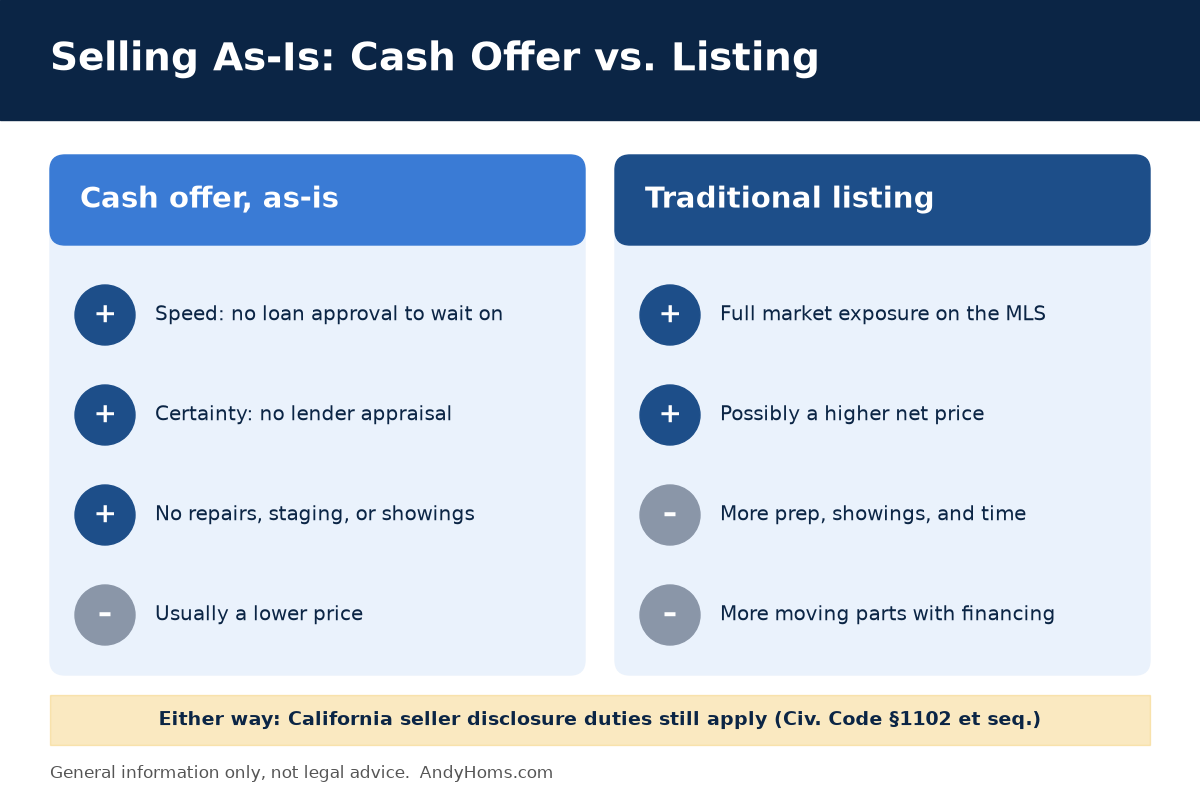
- Speed: With no lender involved, there’s no loan approval to wait on. Escrow can often be set up around your timeline instead of a lender’s.
- Certainty: A cash offer doesn’t depend on the buyer’s loan approval or a lender’s appraisal. Lenders typically order an appraisal when a buyer gets a mortgage (CFPB), and a low appraisal or a loan problem can delay or derail a financed sale.
- No repairs or prep: No contractors, no staging, no weekends of open houses. You can leave behind what you don’t want to move, if the buyer agrees in writing.
- Privacy: Fewer showings and fewer people walking through your home.
The trade-off is price. A cash buyer purchasing as-is is taking on the repair cost, the risk, and the time, and that’s usually reflected in the offer. A cash offer will typically come in below what a fixed-up home could sell for on the open market. Whether that gap is worth the speed and convenience depends on your home and your situation.
Path 2: A traditional listing
Listing on the MLS puts your home in front of every buyer and agent in the market, including buyers paying cash and buyers who love a project.
- Market exposure: More buyers competing for the same home can push the price up. You can even list as-is and let the market tell you what it’s worth.
- Possibly a higher net: Especially if the home needs mostly cosmetic work, the open market may pay more than a cash offer, even after costs.
- More work and more time: Prep, photos, showings, inspections, and buyer repair requests. Even with an as-is listing, buyers usually still inspect and may ask for credits.
- More moving parts: If the buyer is financing, the deal depends on their loan and the lender’s appraisal, and the home’s condition can matter to the lender too.
A simple decision checklist
Ask yourself these questions. If you answer “yes” to most of the first group, a cash offer may fit. If you answer “yes” to most of the second, listing may net you more.
A cash offer may make sense if:
- You need to sell on a specific date or as quickly as possible.
- The home needs major repairs you can’t or don’t want to pay for.
- You live out of the area, or you’re handling a loved one’s home and can’t manage showings.
- Certainty matters more to you than getting top dollar.
A traditional listing may make sense if:
- You have some time and flexibility.
- The home mainly needs cosmetic work, like paint, flooring, or cleaning.
- You can handle showings, or the home is vacant and easy to show.
- Maximizing your net proceeds is your top priority.
Either way, gather what you know about the home before you decide: past inspection reports, repair invoices, permits, and any insurance claims. You’ll need that information for your disclosures no matter which path you choose.
Compare both options side by side
You don’t have to guess. Here’s how I help sellers decide:
- We talk about your goals. Timeline, condition, and what matters most to you. No obligation.
- I see the home. In person or through photos and video.
- You get two numbers. I can get you a cash offer on your home, as-is, and prepare a listing net sheet showing what you could expect to walk away with on the open market after costs.
- You choose. Side by side, with no pressure either way.
If you’re clearing out a home, I’m also happy to refer you to estate sale companies, cleanout and hauling services, contractors, and other local pros I trust. Just ask.
Get your cash offer and listing comparison
I work with homeowners in Rancho Santa Margarita, Mission Viejo, Lake Forest, Ladera Ranch, Laguna Niguel, Laguna Hills, Aliso Viejo, San Clemente, and across South Orange County. Send me a message to get your cash offer and listing net sheet, or request a free home valuation. Call or text me at (949) 229-2704 or email Andy@AndyHoms.com.
This article is general information, not legal or tax advice. Disclosure rules and exemptions depend on your situation, so talk with a California real estate attorney about your specific sale. Laws cited were current as of November 2026.
Andy Homs, Broker-Associate | H&M Realty Group | DRE #01893992 | Equal Housing Opportunity
Let’s talk
Thinking about a move? Let’s make it a smart one.
Whether you’re buying, selling, or investing in South Orange County, I’m happy to talk through your options. No pressure, just straight answers.
Andy Homs, Broker-Associate | H&M Realty Group | DRE #01893992 · Equal Housing Opportunity