
With mortgage rates well above where they were a few years ago, a lot of Orange County homeowners are sitting on loans with rates many of today’s buyers can only dream about. What if a buyer could take over that loan, rate and all? In some cases, they can. It’s called a loan assumption, and it’s one of the most overlooked tools in today’s market.
After 15 years of helping buyers and sellers here in Orange County, I’ve learned that assumptions rarely happen by accident. They happen when someone on the deal knows how to spot the opportunity, explain it, and keep the process moving. Here’s what you need to know.
What is an assumable mortgage?
The Consumer Financial Protection Bureau describes a loan assumption as an arrangement where a buyer takes over the seller’s remaining loan balance on its original terms, including the interest rate and the time left to pay it off. The CFPB notes this may make sense when current rates are higher than the seller’s rate. The buyer pays the difference between the price and the loan balance out of pocket or with their own loan, and the buyer generally has to qualify with the lender.
For context, Freddie Mac’s Primary Mortgage Market Survey put the average 30-year fixed rate at 7.32% for the week of October 22, 2026. Plenty of homeowners locked in far lower rates in past years.
Which loans are typically assumable?
- FHA loans: Federal rules generally let a creditworthy buyer assume an FHA-insured loan (24 CFR 203.512). For FHA loans closed since December 15, 1989, the buyer must generally plan to live in the home, and the lender underwrites the buyer much like a new loan (HUD Handbook 4000.1).
- VA loans: VA guidance says an assumption must be approved when the loan is current and the buyer is creditworthy and agrees to take on the loan (VA Circular 26-23-10). The buyer doesn’t have to be a Veteran.
- USDA loans: A guaranteed USDA loan can be assumed with Rural Development’s approval, if the buyer and property meet program rules (7 CFR 3555.256).
- Most conventional loans: Usually not assumable, because they typically include a due-on-sale clause that lets the lender require payoff when the home is sold.
How the process works
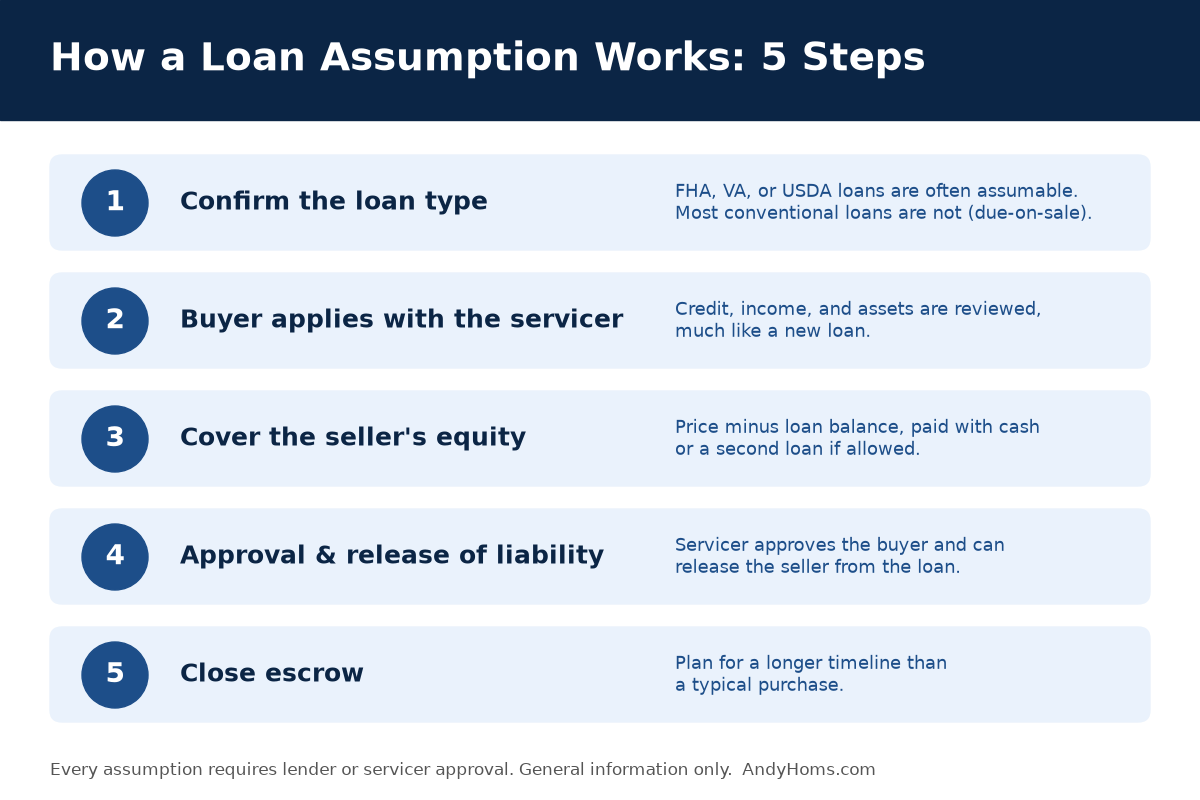
- Confirm the loan type. The seller’s mortgage statement or servicer can confirm whether the loan is FHA, VA, USDA, or conventional.
- The buyer applies with the servicer. The company that services the loan reviews the buyer’s credit, income, and assets.
- Cover the seller’s equity. The buyer pays the gap between the price and the loan balance with cash or, where the servicer and lenders allow it, a second loan.
- Approval and release. Once approved, the servicer can release the seller from liability. For FHA loans, HUD’s handbook describes this release.
- Close escrow. Expect the timeline to run longer than a typical purchase. HUD guidance asks FHA lenders to process assumptions within 45 days of receiving all documents, and VA guidance sets a 45-day decision window for lenders with automatic authority, once the file is complete.
Fees and fine print
- FHA: HUD raised the maximum assumption processing fee to $1,800 (HUD FHA INFO 2024-30). Third-party costs like a credit report may be extra.
- VA: The VA funding fee for an assumption is 0.5% of the loan balance, unless the buyer is exempt (VA.gov).
- VA entitlement: This one is important for Veteran sellers. If the buyer doesn’t substitute their own VA entitlement, the seller’s entitlement can stay tied to that loan until it’s paid off, which may affect their ability to use a VA loan again. If an eligible Veteran buyer substitutes entitlement, the seller’s entitlement can be restored (VA Circular 26-23-10).
An illustrative example
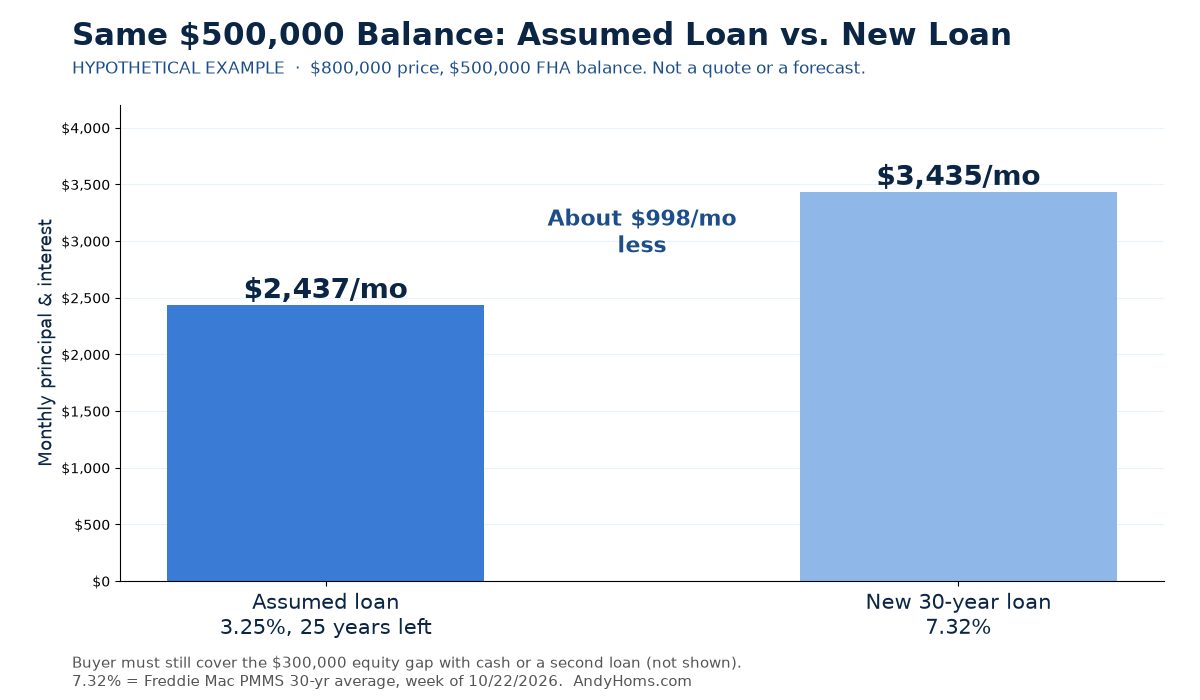
Here’s a hypothetical. These numbers are made up to show the math, not a quote.
Say a home is priced at $800,000 and the seller has an FHA loan with a $500,000 balance at 3.25%, with 25 years left. Assuming that loan, the buyer’s principal and interest would be about $2,437 a month. A brand-new 30-year loan for the same $500,000 at 7.32% would be about $3,435 a month, or about $998 more. But the buyer still has to cover the $300,000 gap, with cash or a second loan, which has its own payment.
Pros and cons
For buyers: the main upside is a potentially lower rate and payment. The downsides are the cash or second loan needed to cover the seller’s equity, a slower timeline, and the need to qualify.
For sellers: an assumable loan can make your listing stand out and may widen your pool of buyers when rates are high. On the other hand, the timeline can be longer, buyers with enough cash for the equity gap can be harder to find, and VA sellers need to understand the entitlement question before they agree.
Why the right agent is the key
Here’s the honest truth: a lot of assumable loans never get assumed simply because no one brings it up. Sellers may not know their loan qualifies, and some agents haven’t been through the process. This is where I come in:
- Educating sellers. I help sellers find out whether their loan is assumable, and walk them through what an assumption could mean for them, including the VA entitlement question.
- Educating listing agents. When I represent a buyer, I reach out to the listing agent, explain how an assumption works, and show how it may attract more buyers.
- Spotting the opportunity. I look for listings that may carry an assumable, lower-rate loan, so my buyers know where to look.
- Coordinating with the servicer. I stay on top of the paperwork, deadlines, and communication with the servicer and escrow, so the deal keeps moving.
No agent can guarantee an assumption will be approved. The servicer or lender makes that call. But knowing the process makes a real difference.
Let’s talk about your options
Whether you’re a buyer hoping to find a lower-rate loan or a seller wondering if yours is assumable, I’m happy to help. Explore my buyer resources or seller resources, or send me a message. Call or text me at (949) 229-2704 or email Andy@AndyHoms.com.
This article is general information, not financial, tax, or legal advice. The example uses hypothetical numbers. Loan programs and fees change, and every assumption requires approval from the lender or servicer, so please talk with a licensed lender about your situation.
Andy Homs, Broker-Associate | H&M Realty Group | DRE #01893992 | Equal Housing Opportunity
Let’s talk
Thinking about a move? Let’s make it a smart one.
Whether you’re buying, selling, or investing in South Orange County, I’m happy to talk through your options. No pressure, just straight answers.
Andy Homs, Broker-Associate | H&M Realty Group | DRE #01893992 · Equal Housing Opportunity